How to Make a Baby Memory Book You'll Actually Finish
There is a baby book in your house right now, or there will be. For the first three weeks it is a sacred object. The birth story goes in. The hospital bracelet, tucked into its little sleeve. A lock of hair taped to the page with the care of a museum curator. And then week four arrives, and life does what life does.
By the first birthday it has quietly become a source of guilt: perfect through month two, blank ever after. If that is your book, this is not a lecture about trying harder. The problem was never your discipline. It was the book.
A memory book you actually finish is built differently from the one you were sold. Here is how to build that one.
The short version. Most baby books get abandoned because they ask for two things real parents don't have: long blocks of time and perfect pages. The best baby memory book ideas all share one rule, which is capture one small thing in the moment, let it be messy, and pick a keepsake format that lives where you already are, which is your phone. The word your baby just said matters more than a tidy layout.
Why most baby books die in a drawer
It isn't a willpower problem. Two design choices, baked into almost every baby book ever sold, set parents up to quit.
The first is batch effort. The book asks you to sit down one evening and reconstruct three months at once. Nobody has that evening. Worse, by the time you try, the details have already gone soft. You will forget the specifics faster than you think, which is not a character flaw but ordinary memory doing its job (we wrote about why you forget your baby's first year separately). A book you fill in from memory is always a little too late.
The second is perfectionism. Those beautiful blank pages punish anything less than beautiful. Miss one monthly photo and the whole project feels spoiled, so you stop rather than keep a book with a gap in it. The design rewards giving up.
A record you keep beats a beautiful one you don't. Everything below follows from that one line.
What actually belongs in it
You do not need all of this. Pick the handful that would break your heart to lose, and let the rest go. The irreplaceable ones aren't the tidy milestones. They're the small, specific, disappearing things.
| What to capture | Why it's the one you'll miss | When |
|---|---|---|
| First words | The exact word, and the wonky way they said it, vanish within a year. This is the first thing memory drops. | The day it happens |
| Their voice | A photo saves the face. Only a recording saves the sound, and the sound is what you'll ache for later. | In the moment |
| Birth story & stats | Time, weight, length, and how the day actually felt. Easy to write once, impossible to reconstruct. | First weeks |
| The pregnancy | The announcement, a bump photo or two, a letter written before they arrived. The prologue you can't shoot after the fact. | Before birth |
| Monthly photo | Same spot, same chair. The growth is the magic, and one missed month doesn't ruin it. | Monthly-ish |
| Hands & feet | Prints shrink into unbelievability. This is the precious keepsake you will not trust was ever that small. | A few times a year |
| A letter to them | Your voice, to their future self. The thing they'll reread as an adult, the heart of any keepsake journal. | Whenever it strikes |
| Family tree | Who they're named for, the branches they came from, the people who will love them from a distance. | Anytime |
| The funny things | The mispronunciations, the tiny opinions, the private family words. Pure gold, entirely forgettable. | As they land |
If a blank page intimidates you, a handful of gentle prompts helps more than any fancy album: Today you loved… Today you learned… The thing I never want to forget is… Documenting the ordinary days, the rhythm of a Tuesday, matters as much as the big firsts, because the ordinary is exactly what memory throws away first.
Photograph the face, but record the voice. The face you will remember for years. The voice is the very first thing to go, and it is the thing that, played back, undoes every parent in the room. If you keep only one kind of thing, keep that.
Physical book or app? Pick the one you'll keep up with
When you go to choose or buy a baby book, the real question isn't the cover or the page count. It's which format you'll still be keeping in a year. The eternal debate has a boring, correct answer: the best baby book is the one that's open when the moment happens. Here's the honest trade.
A physical book is a real heirloom. It smells like paper, it survives dead batteries, and handing it over one day has a weight a screen can't match. It is also the format most likely to end up half-finished, because it demands you be at a desk, with the right pen, with time. It lives in a drawer. Moments do not happen in a drawer.
A digital or app-based book loses the tactile magic, and you should mind that. What it wins is everything about actually keeping it. It is already in your pocket when the word arrives. It captures a photo, the date, and the voice in one motion, so you're documenting the moment instead of reconstructing it. It backs itself up, it can hold more than one language, and family far away can share in the growth the same day. And when it's full, you can print those precious stories into the paper album or heirloom you wanted all along, complete rather than abandoned.
Many parents, sensibly, do both: the app for catching the moments as they fly, the printed book for the shelf. The point is not the material. The point is which one is open at 7:14pm on a Tuesday when your daughter looks at the dog and says, clear as anything, her first word.
The one-tap habit that survives real life
Here's the whole method, and it fits in a sentence: capture in the moment, not in a batch. When something happens, you get one small thing down before it's gone, and you accept that one small thing as enough.
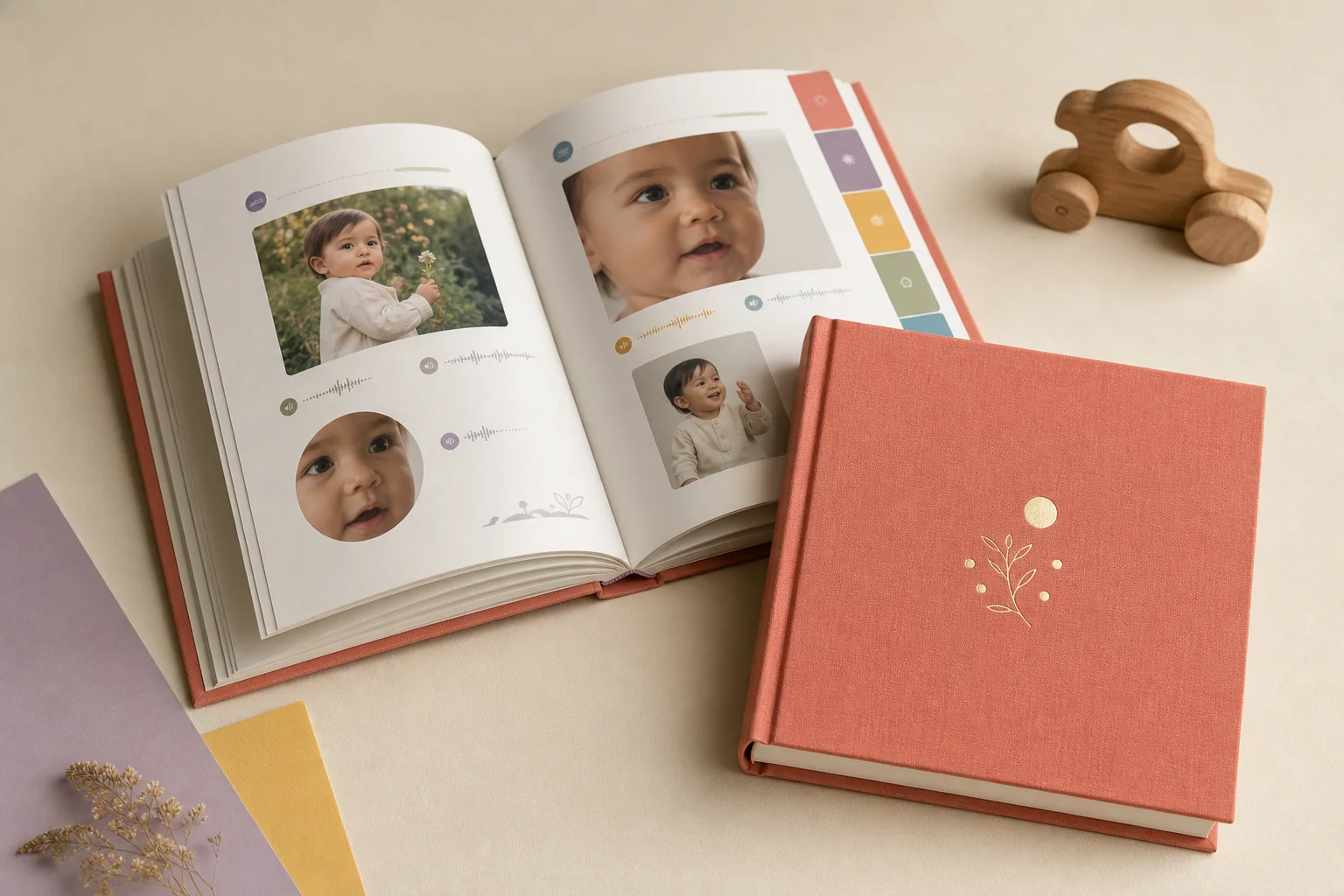
This is exactly what Saylings is built to do for the part that disappears fastest. When your child says a new word, you open it, tap once, and the word is saved with a photo and a recording of their real voice, in whatever language they said it. No sitting down. No blank page glaring back. The book fills itself in from the moments you were living anyway, and a year of first words assembles itself while your back is turned.
You are not making a scrapbook you have to finish. You are catching things as they go past, and letting the finished thing be the sum of them.
The baby book that fills itself in
Saylings keeps the part you'll miss most, your baby's first words, each with a photo and their actual voice, in every language they speak. One tap on the day it happens. No blank pages, no guilt.
Join the waitlist — launching soon on iOSCommon questions
What should I include in a baby memory book?
Start with the irreplaceable things: the birth story, the first words, and a recording of your baby's actual voice. Add monthly photos, hand and footprints, and a letter or two. Skip anything you won't keep up with. A few kept moments beat a long unfinished list.
Is a physical or digital baby book better?
Whichever you'll actually keep up with. Physical books are lovely heirlooms but easy to abandon, because they ask for big blocks of time. A digital or app-based book lets you capture a moment the second it happens, with a photo and voice, and print it later. Many parents do both.
When should I start a baby memory book?
Whenever you're reading this. There's no wrong time and no catching up required. Start from today and capture forward. The best moment to record a first word is the day it arrives.
Sources
- Yates TS, Ellis CT, Turk-Browne NB, et al. Hippocampal encoding of memories in human infants. Science. 2025;387(6740):1316–1320. Published 20 March 2025. doi.org/10.1126/science.adt7570