When Do Babies Start Forming Memories?
Your one-year-old is on the kitchen floor, stacking the same three cups they stacked yesterday, narrating the whole operation in a language only they speak. Right now, in that small head, something is being recorded. For a long time, science was fairly sure it wasn't.
We were wrong about that. Babies make memories far earlier than anyone used to believe. The catch is the part nobody warns you about: neither of you will keep them. Your child won't remember this morning, this year, or almost anything before their third birthday. And you, the one person who could hold it for them, will forget more of it than you can imagine.
That sounds bleak. It turns out not to be, quite. A study published in 2025 rewrote the story in a way that's oddly comforting, and it points at something you can actually do.
The short version. Babies start forming memories in the first year. A 2025 Yale study found infants over 12 months already encoding events through the hippocampus, the brain's memory hub. We lose those years not because the memories were never made, but because we can't retrieve them later. That's infantile amnesia. Which means the only lasting record of your baby's first words is the one someone chooses to keep.
When do the first memories actually form?
There isn't a single switch. Different kinds of memory arrive on different schedules, and the famous one, the memory of events, is the last to show up.
Some memory is there almost from the start. Within days of birth a baby knows their mother's voice and face. By two or three months they smile at the people they see most, which is recognition doing its quiet work. Through the first two years, two other systems build steadily: procedural memory, for how to do things, and semantic memory, for facts about the world.
The classic proof is charming. In experiments running from the 1980s, the psychologist Carolyn Rovee-Collier tied a ribbon from a baby's ankle to a crib mobile. Babies as young as six months, given a single minute of practice, kicked to make the mobile move again a full day later. They plainly remembered. They just couldn't tell anyone.
What stayed uncertain for decades was episodic memory: the memory of specific events, the kind that later becomes autobiographical memory, the running story you tell about your own life. In March 2025, researchers at Yale and Columbia put 26 infants, aged four months to two years, inside an MRI scanner and showed them images. When the hippocampus lit up as a baby met a new picture, that baby was more likely to recognise it later. The effect was strongest after 12 months (Yates et al., Science, 2025).
Translation for the kitchen floor: by their first birthday, your baby is recording events. The camera is on.
| Kind of memory | Roughly when | What it looks like |
|---|---|---|
| From birth | Recognition | Knows a parent's voice and face; soon, familiar faces earn a smile |
| First year | Procedural & semantic | Remembers how to do things and facts about the world; the Rovee-Collier kicks |
| Around 12 mo | Episodic (events) | The hippocampus begins encoding specific moments (Yale, 2025) |
| Age 2–3 | First autobiographical memory | The earliest thing most adults can actually recall as their own |
So why can't any of us remember being a baby?
Try it. Reach for your own earliest memory and you'll land somewhere around age three, maybe two if it's vivid. Everything before that is blank, or borrowed from a photograph. Psychologists call this infantile amnesia, and it's a near-universal phenomenon: most people, and most children once they're old enough to be asked, recall almost nothing before age three and very little before seven.
The old explanation was simple and a little sad. Babies, it was assumed, just couldn't form real memories yet. No language to pin them to, a hippocampus still under construction, so nothing was saved.
The 2025 study is why that explanation is now on shaky ground. If infants are demonstrably encoding memories through the hippocampus, the memories are being made. The senior author, Nick Turk-Browne, suggested they may persist into preschool age, perhaps longer, before fading, and might even survive in some form we simply can't reach. The open question is no longer whether babies record these years, but why the recordings become impossible to play. The failure isn't in the recording. It's in the playback.
Encoding versus retrieval, in one line. Encoding is writing the memory down. Retrieval is finding it again later. Infantile amnesia looks less like a blank page every year and more like a locked drawer. The pages are in there. The key is what's missing.
It's a small reframe with a large feeling attached. The morning your baby first said your name did not vanish into nothing. It's somewhere they can't get to, and somewhere you'll struggle to reach too.
The forgetting nobody warns you about
Here's where the science articles stop and the parenting begins. Infantile amnesia is your child's forgetting. There is a second forgetting, quieter and closer to home, and it's yours.
You will swear you'll remember the first word. Everyone swears it. Then ask a parent of a ten-year-old what that word was, exactly, and on what date, and how it came out. Watch them reach for it, and reach, and come back with a shrug and a "something like 'dada,' I think."
The specifics go first. The exact mispronunciation, the particular morning, the way they looked up to check your face for approval. Within a year the edges soften. Within a few, the whole scene has dissolved into a general, golden warmth with no detail left in it.
This isn't a flaw in you. It's how ordinary memory works: the brain keeps the gist and quietly discards the particulars, because it would drown otherwise. But first words are the particulars. "More," at thirteen months, with the little insistent hand. "Câine," for the neighbour's dog, before the English one arrived. The gist has no room for those.
Your baby forgets because their brain is still being built. You forget because yours is doing exactly what it was designed to do. Two forgettings, pointed at the same handful of irreplaceable moments.
How to keep what memory can't
You can't cure infantile amnesia, and you can't switch off your own forgetting. What you can do is move the moment somewhere that doesn't forget.
For most of history that meant a baby book: a lovely thing, filled in devotedly for three weeks and then lost to a drawer. No judgement. The impulse was right even when the follow-through wandered.
The pieces worth keeping are small and specific. The word itself. The date it arrived. And, if you can manage one thing more, the sound of it. A photo saves the face beautifully, and the face is the thing you'll actually remember longest. The voice is the first to go, and no photo has ever held it.
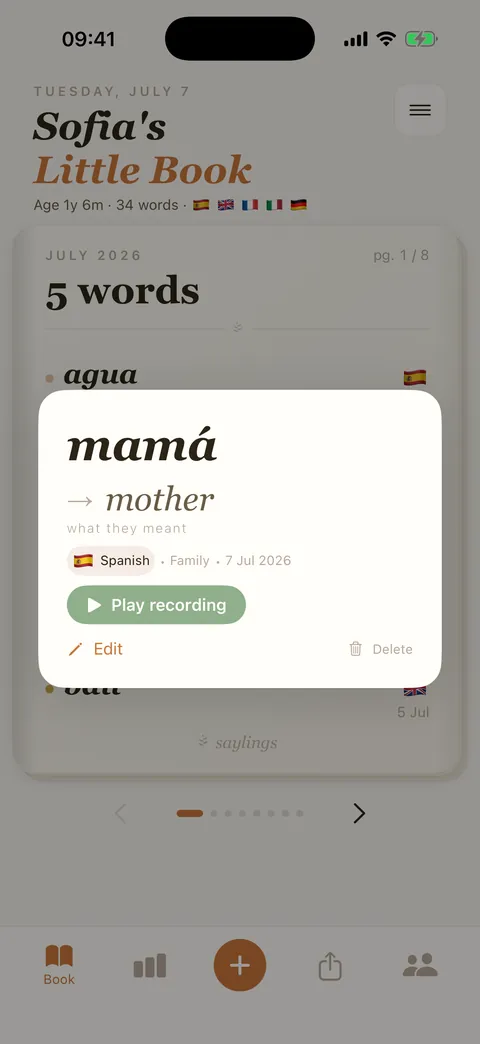
That last part is the whole idea behind Saylings. It's a place to keep each first word the moment it lands, with a photo and a recording of your child's real voice saying it, in every language they speak. Not a book you have to keep up with. A quick tap on the morning it happens, and then it's safe.
It isn't really for them, if we're honest. Your child will never remember the first time they said "mama." But one day they'll get to hear it. And you'll get to keep the morning it happened, instead of trusting it to the one place that always, eventually, lets go.
Be the memory they can't keep
Your baby is making memories today that neither of you will hold onto. Saylings keeps each first word for them, with a photo and their actual voice, in every language they speak.
Join the waitlist — launching soon on iOSCommon questions
When do babies start forming memories?
From birth, babies form simple recognition and procedural memories, like knowing a parent's face and voice. A 2025 Yale study found infants already encoding event memories through the hippocampus by around 12 months, earlier than researchers long assumed.
Will my baby remember their first year?
No. Because of infantile amnesia, most people's earliest lasting memory dates from about age 2 or 3, and we recall very little before age 7. Recent research suggests the memories do form but later become hard to retrieve, rather than never forming at all.
At what age do first memories usually start?
Most adults' earliest retrievable memory is from around age 2 to 3. Anything earlier is almost always a family story or a photograph you have absorbed, not a true recollection of the event itself.
This article is general information for parents, not medical advice. Every child develops at their own pace. If you have concerns about your child's memory, hearing, or development, talk to your pediatrician.
Sources
- Yates TS, Ellis CT, Turk-Browne NB, et al. Hippocampal encoding of memories in human infants. Science. 2025;387(6740):1316–1320. Published 20 March 2025. doi.org/10.1126/science.adt7570
- Yale News. Why don't we remember being a baby? New study provides clues. 20 March 2025. Retrieved 20 July 2026. news.yale.edu
- Scientific American. Why You Can't Remember Being Born: A Look at 'Infantile Amnesia'. Retrieved 20 July 2026. scientificamerican.com
- Greater Good Magazine, UC Berkeley. Why Can't We Remember Our Early Childhood? Retrieved 20 July 2026. greatergood.berkeley.edu